For business owners overwhelmed by merchant cash advances, filing bankruptcy for MCA debt can begin to seem inevitable. Daily withdrawals have depleted working capital, additional borrowing has compounded the problem and the company can no longer support its accumulated obligations.
Revenue may still be substantial. Customers continue placing orders, employees continue working and the underlying operation may still be generating positive earnings before debt service. Yet the existing entity has reached a point where its financial obligations are no longer sustainable.

Start Your Free Debt Relief Plan Now
Connect with experts who help businesses get back on track.
No obligation. Available same-day.
The owner recognizes that a fundamental restructuring is necessary and begins considering Chapter 11. It is the restructuring process most business owners know, and the severity of the financial distress can make bankruptcy appear to be the only remaining option.
Unfortunately, traditional Chapter 11 has a particularly poor record of delivering the outcome small and lower-middle-market owners expect when they file: emerging from bankruptcy with their obligations restructured and their businesses still under their ownership. More than eight out of ten small and lower-middle-market Chapter 11 filings fail to achieve that outcome, with the majority ultimately resulting in liquidation or a court-ordered sale of the business.
Bloomberg Businessweek captured the predicament confronting smaller business owners:
“Your company is on the brink, you can’t pay your employees or suppliers and now you’re expected to master the complex vocabulary of federal bankruptcy law… The process looks expensive and time-consuming, and the chance of emerging with a going concern seems slim…”
The concerns extend well beyond the owner’s unfamiliarity with bankruptcy law. Chapter 11 provides powerful legal protections, but the expense, complexity and administrative demands of the proceeding can exceed what a smaller company can afford.
Experienced restructuring professionals, including bankruptcy attorneys, have long recognized that Chapter 11 should ordinarily be a last resort. Where a restructuring can be accomplished reliably outside bankruptcy, avoiding the expense, disruption and procedural requirements of a federal court proceeding is widely regarded as preferable.
Why Chapter 11 Often Doesn’t Work for Smaller Businesses
Chapter 11 lets a struggling company restructure its debts while it keeps operating. As soon as the company files, a court protection called the automatic stay generally stops most creditors from collecting, including MCA providers collecting on advances the company took before filing. For a business losing cash to several daily or weekly withdrawals, that relief can be substantial.
But stopping those payments is only the beginning of a bankruptcy reorganization. The company must still operate, pay its employees, purchase inventory and fulfill customer orders, now with the additional expense of bankruptcy counsel, financial professionals, court administration and ongoing reporting requirements. Those expenses are paid from the same limited resources needed to stabilize the operation.
Management generally remains in possession, although the freedom to make significant commercial decisions is constrained by court supervision and the rights of parties participating in the proceeding. Financing arrangements and major transactions may require judicial approval or become subject to creditor objections.
For businesses dependent upon banks, factors or asset-based lenders, access to operating liquidity presents another challenge. When a lender’s loan is secured by the company’s receivables, the money customers pay in is treated as the lender’s collateral. In bankruptcy, the company may not be able to use that money without the lender’s consent or the court’s approval. So even after the MCA withdrawals stop, the business may still lack the cash it needs to keep operating while the case moves forward.
The public nature of bankruptcy introduces difficulties that are harder to measure. A vendor that previously extended thirty-day terms may begin requiring payment in advance. A customer concerned about continuity may choose another supplier. Key employees may begin considering opportunities elsewhere. None of those responses requires an actual interruption in operations, but each can make the eventual reorganization more difficult.
Meanwhile, management is attempting to preserve those relationships while devoting time and financial resources to the requirements of the proceeding. As the case continues, professional expense accumulates, and the company’s ability to maintain ordinary operations may become increasingly strained.
Large corporations frequently have the liquidity, professional infrastructure and access to capital necessary to manage this process. A privately held lower-middle-market company may have little excess cash or management capacity available beyond what is required to run the operation itself.
Subchapter V was created to make Chapter 11 more accessible to qualifying smaller businesses by reducing certain procedural burdens. It can improve the prospects for reorganization, but the company remains in a public, court-supervised bankruptcy proceeding with professional expenses and ongoing financing requirements.
There are circumstances where those burdens are justified. A company operating through numerous subsidiaries, hundreds of leases or extensive contractual arrangements may require the centralized authority of a bankruptcy court. The ability to assume, assign or reject certain contracts and leases, impose binding treatment through a reorganization plan or resolve disputes that cannot be addressed outside court can make Chapter 11 indispensable.
A smaller company with a less complicated operating structure may require substantial financial restructuring without needing those particular judicial powers. Subjecting it to the same bankruptcy framework can impose costs and uncertainty that add little to the desired outcome.
Restructuring Under Commercial Law Instead of Bankruptcy Law
For smaller and mid-sized businesses, comprehensive restructuring can often be accomplished through established commercial law rather than federal bankruptcy law. The underlying financial obligations may be unsupportable, and the existing entity may be insolvent, without the restructuring itself requiring a court-supervised proceeding.
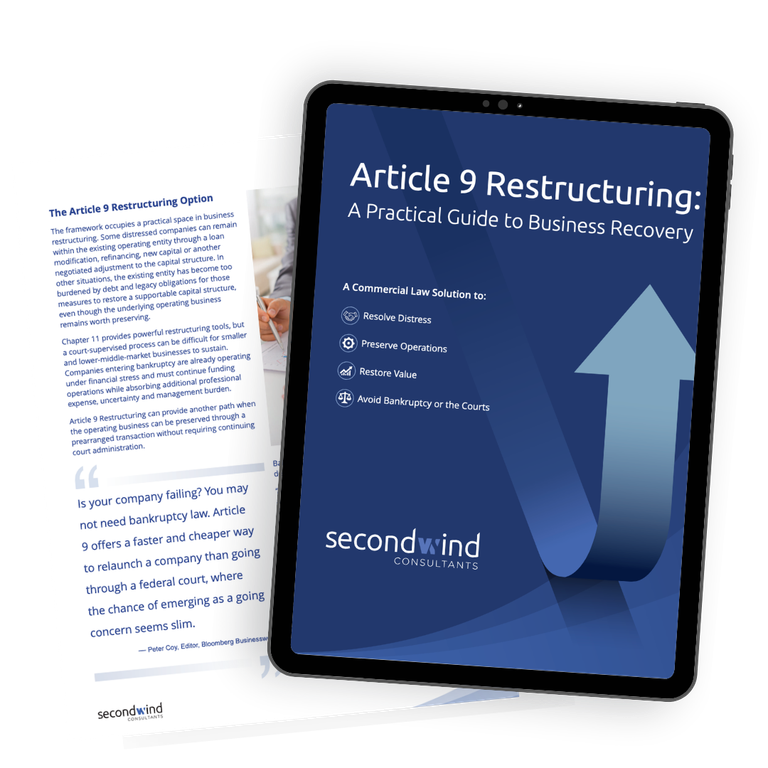
Bloomberg Businessweek examined this approach in an article titled “Is Your Company Failing? You May Not Need Bankruptcy Law,” explaining why smaller businesses can often be better served by restructuring outside bankruptcy.
As the publication observed, “…the relevant section if your company is failing is Article 9”.
Article 9 of the Uniform Commercial Code governs secured transactions, including secured lenders’ rights to dispose of collateral after default through a commercially reasonable transaction. Those rights provide the legal foundation for Article 9 Restructuring—an established out-of-court framework for preserving an operating business whose existing legal entity can no longer support its accumulated obligations.
The process is substantially more comprehensive than the sale of collateral itself. Through a cooperative, prepackaged transaction, the business owner and incumbent senior secured lender work together to preserve the underlying operation while maximizing the lender’s recovery. That recovery is tied to the value of its collateral, and that value may be better supported by an operating business with continuing customer relationships, employees, inventory movement and revenue than by assets separated from the operation. The owner has a corresponding interest in preserving the business and the future economic opportunities it can provide.
Those interests are addressed before the transaction is implemented. An independent appraisal establishes the value of the operating assets. The senior lender’s recovery is determined, incoming asset-based financing is arranged and the requirements for maintaining operations are coordinated in advance.
The incumbent senior lender then exercises its rights under Article 9 to conduct a commercially reasonable disposition of the operating assets into a new entity, free of the qualifying subordinate liens discharged through the transaction. The former entity’s contractual debts and legacy business liabilities remain behind rather than accompanying the operating assets into the continuing business. The former entity is subsequently wound down, while the underlying operation continues with its customers, workforce, assets and productive capacity intact, supported by a clean balance sheet and new financing.
A properly structured, prepackaged Article 9 Restructuring generally takes four to six weeks and does not require a bankruptcy filing or court approval of the Article 9 transaction.
As Bloomberg Businessweek noted, “Article 9 has been used for years to resolve companies.”
Restructuring through Article 9 versus Chapter 11
Chapter 11 and Article 9 Restructuring can both preserve an operating business through a fundamental change in its financial structure. For a smaller company, however, the resources required to complete the restructuring can be as consequential as the financial arrangements ultimately achieved.
Speed and Cost
Much of the work involved in an Article 9 Restructuring occurs before the secured-party disposition. The independent valuation, arrangements with the incumbent lender, acquisition financing and operating transition are developed as parts of a single prepackaged transaction. By the time the transfer occurs, the commercial arrangements necessary to complete the restructuring have already been assembled.
Chapter 11 introduces a different operating environment. Professional fees, reporting obligations, court proceedings and creditor participation continue while the debtor attempts to implement its restructuring. Financing or a proposed transaction that appeared workable at the outset may become contested, requiring additional time and expense to resolve.
A smaller company has to support that process while continuing ordinary operations. The cost is not confined to professional invoices. Working capital consumed by the proceeding cannot also be used for inventory, payroll or customer fulfillment, while the passage of time can further weaken vendor terms and commercial relationships.
An Article 9 Restructuring still requires sophisticated legal, financial and transactional work. What it avoids is the additional expense of administering the transaction through a continuing federal bankruptcy proceeding.
Privacy and Commercial Control
A bankruptcy filing becomes a matter of public record, bringing financial disclosures, formal creditor participation and judicial oversight into the company’s affairs. These requirements serve legitimate purposes when the court is exercising powers that affect the rights of creditors and other interested parties. But they also expose the restructuring to objections, hearings and potentially competing proposals that can complicate the original plan.
Management ordinarily remains in possession in Chapter 11, although significant decisions are made within that court-supervised environment. An Article 9 Restructuring allows the owner, incumbent senior secured lender and necessary financing participants to establish the transaction’s essential arrangements commercially before implementation. Creditor rights and statutory requirements still apply, but the restructuring is not administered through an ongoing bankruptcy case.
The process can also be conducted privately among the necessary participants, subject to required notices and applicable legal obligations. For a smaller enterprise, preserving customer confidence, supplier relationships and employee stability while the financial restructuring is being completed can be particularly valuable.
Flexibility and Financial Renewal
The existing legal entity may have accumulated obligations that the cash flow of the underlying operation can no longer support. Continuing to carry those liabilities, even under modified terms, may not produce a sustainable financial structure. Article 9 Restructuring addresses that condition through the transfer of the operating assets into a new entity. The senior lender’s recovery, incoming financing and arrangements for continued operations are structured around the economics of the business that will continue after closing.
The operating assets transfer free of the qualifying subordinate liens discharged through the transaction, while the former entity’s legacy contractual debts remain behind. The continuing operation can then support a new financing relationship based on its acquired assets and expected operating performance, rather than the unsustainable obligations of the former entity. The transaction can also accommodate negotiated arrangements with the incumbent senior lender, including additional recovery tied to future performance where the economics support it.
For smaller and mid-sized businesses, having these elements arranged before implementation can substantially reduce the financial and operational uncertainty associated with restructuring. The objective is a sustainable, ongoing enterprise, achieved without incurring judicial procedures the transaction does not require.
Preserving a Path to Resolve Personal Guarantees
Personal guarantees frequently leave business owners facing substantial financial exposure even after the company’s obligations have been addressed. Those guarantees remain separate obligations and are not automatically discharged through an Article 9 Restructuring.
Preserving the underlying operating business, however, can preserve the opportunity for continued compensation and future earnings associated with the operation. That income can provide a practical foundation for negotiating affordable settlements of personal-guarantee obligations over time. For an owner whose principal earning capacity is tied to the business, maintaining that economic opportunity can be important to resolving personal exposure without filing personal bankruptcy.
Before Filing Bankruptcy for MCA Debt, Consider Article 9 Restructuring
A business overwhelmed by merchant cash advances may require comprehensive restructuring, but Chapter 11 need not be the starting point simply because the existing entity can no longer satisfy its obligations.
For lower-middle-market businesses whose underlying operations retain meaningful economic value, a prepackaged Article 9 Restructuring can preserve and relaunch that operation through established commercial law, with a clean balance sheet and new financing, without the expense and continuing administration of bankruptcy.
Second Wind Consultants works with business owners and incumbent senior secured lenders to structure cooperative Article 9 Restructurings that preserve operating businesses while maximizing lender recovery. Before filing Chapter 11, contact Second Wind Consultants to determine whether Article 9 Restructuring offers a better solution.