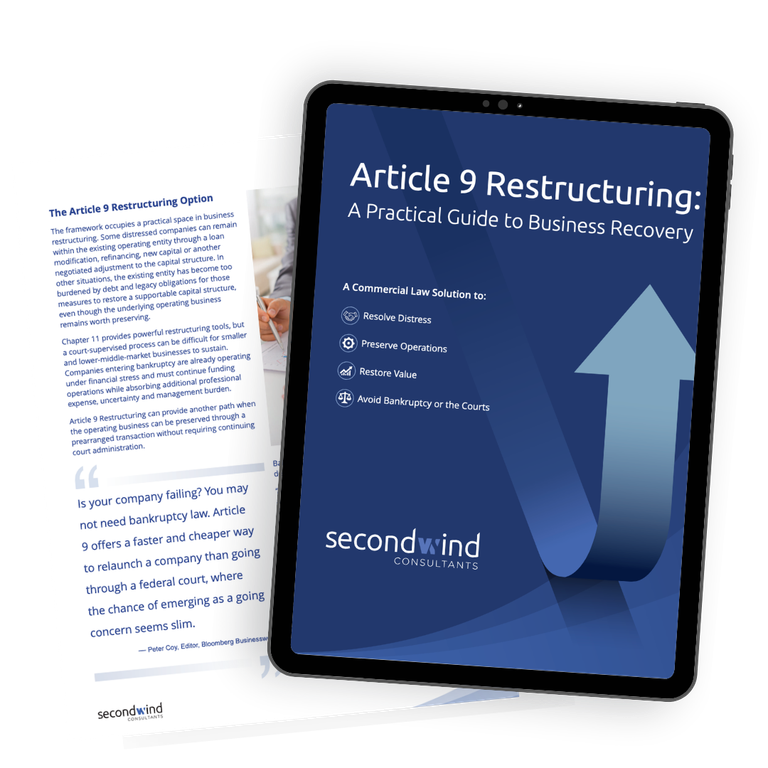
An Article 9 Restructuring is an out-of-court business restructuring under commercial law that preserves operations and relaunches the business with a clean balance sheet, without bankruptcy.
An operating entity can become financially insolvent while the underlying business continues to generate substantial economic value. The company may be unable to service its accumulated debt, even as its operations continue producing positive EBITDA, serving customers, supporting employment and retaining significant going-concern value. The financial condition of the existing entity and the economic value of the business operating within it are not necessarily the same.
Article 9 Restructuring is designed to preserve that underlying business when its existing capital structure has become unsupportable. Through a cooperative, prepackaged transaction, the business owner and incumbent senior secured lender work together to preserve the operating business while maximizing the lender’s recovery. Exercising its rights under the Uniform Commercial Code, the senior lender transfers the operating assets into a new entity, free of the subordinate liens discharged under commercial law. The former entity’s debts and legacy liabilities remain behind.
The business continues operating through the new entity, retaining its workforce, customers and productive capacity, now supported by a clean balance sheet and financing appropriate to its ongoing operations.
The process generally takes four to six weeks and does not require a bankruptcy filing or court approval of the Article 9 transaction. As described by LA Times Studios Business Magazine, Article 9 Restructuring “supports solutions that protect jobs, maintain operations and maximize recovery for senior lenders without courtrooms.”
What Is the Article 9 Process?
Article 9 of the Uniform Commercial Code establishes the rights of secured lenders when a borrower defaults on obligations secured by business assets. Under UCC §9-610, a secured lender may sell those assets through a commercially reasonable transaction. Section 9-617 establishes the legal effect of that sale, including the discharge of qualifying liens against the transferred assets.
A distinction worth noting is that, in situations when a business has no remaining operating value worth preserving, an Article 9 asset sale may be used to liquidate its collateral at the end of the business’s life. That is not the application of Article 9 being discussed here. When the underlying business continues to generate economic value despite an unsupportable debt burden, Article 9 Restructuring uses the same legal mechanism for a very different purpose: transferring the ongoing operation into a new entity while preserving its employees, customer relationships, business continuity and going-concern value.
A prepackaged Article 9 Restructuring is organized cooperatively between the business owner and incumbent senior secured lender. The owner seeks to preserve the business, while the lender seeks to maximize recovery by avoiding a formal liquidation—and both seek to avoid a bankruptcy filing. The transaction is arranged around these shared objectives.
Independent valuation, replacement financing and the arrangements necessary to maintain business continuity are coordinated in advance. When the Article 9 transfer occurs, the business continues operating through the new entity under a sustainable financial structure.
How Does Article 9 Restructuring Work?
The restructuring begins by assessing whether the underlying operation retains value worth preserving despite its existing debt burden. The business owner and incumbent senior secured lender then align around a cooperative transaction that preserves the operation and maximizes recovery. Independent valuation and transaction structuring establish the commercial foundation, replacement financing is arranged, and the senior lender completes the Article 9 transfer so the business can continue without interruption.
1. Senior Lender Participation and Recovery
For a senior secured lender, formal liquidation can be an expensive way to recover the value of a distressed credit. Equipment, inventory and receivables may be worth considerably more within a functioning business than when separated from the operation that produces and supports them.
A prepackaged Article 9 Restructuring preserves operating value and ordinarily produces a greater recovery than formal liquidation. The lender receives the value supported by its collateral without destroying the business responsible for generating it. The lender also avoids the costly and value-eroding process of a bankruptcy.
The incumbent lender and business owner consequently share a commercial interest in preserving the operation and completing an orderly restructuring outside of court.
2. Independent Valuation and Transaction Structure
An independent appraisal establishes the value of the operating assets. The restructuring team evaluates the business’s financial performance, cash requirements and capacity to support replacement financing once the unsupportable debt burden has been removed.
The appraisal supports the lender’s recovery analysis and provides a valuation foundation for the commercially reasonable disposition required under Article 9.
The transaction incorporates the senior lender’s recovery, the acquisition financing and the operational arrangements necessary to maintain business continuity.
3. Acquisition Financing
An incoming asset-based lender underwrites the operating assets and arranges financing for the transaction.
The financing is established before the transfer, allowing the incumbent secured lender to receive its recovery while the operating business continues without interruption.
The incoming lender evaluates the value of the assets and the financial performance of the continuing operation, without the unsupportable liabilities that impaired the former entity’s balance sheet.
4. Secured-Party Disposition and Relaunch
The incumbent senior lender provides the notices required under Article 9 and conducts a commercially reasonable disposition under UCC §9-610.
The operating assets transfer into the new entity, free of the subordinate liens discharged through the transaction. The incoming lender establishes its first-priority secured position, and the business continues operating under its new financial structure.
For employees, customers and many vendors, the transition may involve little visible change. The operating business retains its workforce, management, products, services and established commercial relationships.
What Happens to the Debt in an Article 9 Restructuring?
The new operating entity receives the transferred assets without assuming the former company’s contractual debts and legacy liabilities merely through the acquisition.
The secured-party disposition discharges the security interest being enforced and qualifying subordinate security interests and liens under Article 9. With its operating assets transferred, the former entity is left without the operating value that formerly supported its obligations. Its legacy business debts and liabilities do not follow the operating assets into the new entity, and the former entity is subsequently wound down.
The continuing business operates through a new balance sheet supported by its acquired assets, operating cash flow and replacement financing.
Statutory Compliance and Transaction Execution
An Article 9 Restructuring is conducted through the incumbent senior secured lender, exercising its statutory rights under commercial law. The transaction requires independent valuation, proper creditor notices, commercial reasonableness and documentation consistent with the Uniform Commercial Code.
The continuation of the underlying business does not transfer the former entity’s contractual liabilities to the new operation. A properly conducted secured-party disposition establishes the rights conveyed in the collateral, while the surrounding restructuring arrangements preserve the productive business.
Experienced restructuring professionals coordinate the transaction through the senior lender, integrating valuation, secured-creditor rights, financing and operational continuity. The integrity of that process is essential to achieving the intended financial and commercial outcome.
Critical Vendors, Leases and Continuing Obligations
A clean balance sheet does not prevent the new operating entity from preserving commercial relationships important to the business.
A critical supplier may be necessary to maintain production or distribution. An existing lease may be essential to retaining a location, equipment or other operating capability. The new entity may negotiate new arrangements or agree to carry forward selected obligations, in whole or in part, where doing so benefits the continuing operation.
These commitments are made at the discretion of the new operating entity rather than arising from a general transfer of the former company’s liabilities. Certain contracts, leases and licenses may also require separate assignment arrangements or third-party consent.
Personal guarantees are separate obligations and are addressed independently, as discussed below.
What Happens to Personal Guarantees After Article 9 Restructuring?
Personal-guarantee exposure frequently represents one of the most serious consequences of business insolvency. A guarantor may face substantial personal claims even after the underlying business has ceased operating. Formal liquidation can eliminate the very income-producing operation from which those obligations might otherwise be resolved.
Article 9 Restructuring preserves that source of economic value.
Following the restructuring, the guarantor can continue earning income from the relaunched operating business. That continuing earning capacity provides a practical foundation for negotiating affordable settlements of personal-guarantee obligations over time.
Personal guarantees are addressed separately from the secured-party asset transfer. Their resolution will reflect the guarantor’s financial circumstances, available personal assets and anticipated earnings, creating a path toward resolving personal exposure without requiring personal bankruptcy. In short, preservation of the business itself offers the path to affordable personal guarantee resolution through the continued generation of business value, rather than through a personal bankruptcy.
Is Article 9 Restructuring the Same as Debt Settlement or Creditor Negotiation?
The terminology surrounding business debt relief has become increasingly confused as some providers offering conventional payment modification services describe those services as Article 9 Restructuring.
Article 9 Restructuring is not a debt-negotiation or payment-modification program. Its defining mechanism is a secured-party disposition under the Uniform Commercial Code, through which the operating assets transfer into a new entity. The transaction is arranged cooperatively with the incumbent senior secured lender and does not depend upon negotiating reductions or revised payment terms with individual junior creditors.
Conventional business debt-relief and settlement programs generally seek modified payment arrangements with existing creditors. These commonly involve reduced periodic payments achieved through extended repayment schedules rather than meaningful principal reductions. The existing legal entity remains responsible for the obligations, which continue to burden its balance sheet.
Junior creditors receive the required notices and retain their applicable rights, but their individual approval is not required for the secured-party disposition.
A series of negotiated payment modifications does not accomplish the same restructuring. The legacy obligations remain with the existing entity, which must continue supporting them under amended terms. Article 9 Restructuring instead uses the senior secured lender’s statutory transfer rights to move the operating assets into a new entity, free of the liens discharged through the transaction. The former entity’s contractual debts and legacy liabilities do not accompany those operating assets
Does a UCC-1 Filing Mean a Business Qualifies for Article 9 Restructuring?
A UCC-1 financing statement is commonly used to perfect a secured creditor’s interest in business assets. Its existence does not establish whether a company requires an Article 9 Restructuring.
A business with unsupportable debt, but an underlying operation capable of producing economic value, may be a candidate for Article 9 Restructuring.
The existing entity may be insolvent, unable to service its obligations or facing creditor enforcement. Yet its customers, workforce, operating systems and productive assets may retain substantial going-concern value.
An initial restructuring assessment establishes the value of the continuing operation, the incumbent senior lender’s secured position and the financing necessary to preserve the business.
The size of the company is less significant than the condition of its debt obligations and the economic value remaining in its operations.
Article 9 Restructuring vs. Chapter 11 Bankruptcy
Both Article 9 Restructuring and Chapter 11 bankruptcy can preserve operating businesses that can no longer continue under their existing financial structures.
Chapter 11 provides a federal judicial framework with powers unavailable through ordinary commercial transactions, including the automatic stay, court-supervised financing and a confirmed plan capable of binding affected creditors. Those powers can be essential where the complexity of the financial distress requires them.
For smaller and middle-market businesses, the substantial cost and duration of Chapter 11 can consume resources needed to preserve operations. Customers may become uncertain, vendors may tighten terms and management attention can be diverted toward the demands of the proceeding.
Article 9 Restructuring operates outside bankruptcy court. The incumbent senior lender exercises its secured-party rights under commercial law through a prearranged, commercially reasonable transaction.
Where the restructuring objectives can be accomplished through this process, the business can continue without the expense, delay and public proceedings associated with Chapter 11.
Bankruptcy remains an important restructuring framework when judicial powers are necessary. The appropriate process follows an assessment of the underlying operating business, creditor structure and commercial requirements of the restructuring.
Who Conducts an Article 9 Restructuring?
A prepackaged Article 9 Restructuring requires experienced professionals capable of coordinating secured-lender rights, independent valuation, acquisition financing and the preservation of business operations.
The restructuring team assesses the underlying operation, develops the transaction economics and arranges the financing and operational transition. The incumbent senior secured lender conducts the Article 9 disposition, with counsel addressing statutory compliance and transaction documentation.
The transaction proceeds through the secured lender’s rights under commercial law. It cannot be replicated through an informal asset transfer or a program of negotiated creditor payment modifications.
Successful execution depends upon coordinating the financial, legal and operational elements before the disposition occurs, with the continuing business prepared to operate under its new structure immediately following the transfer.
How Long Does Article 9 Restructuring Take?
A prepackaged Article 9 Restructuring generally takes approximately four to six weeks.
Independent appraisal, senior-lender participation, acquisition financing and operating transition arrangements are coordinated before the secured-party transfer. Once the required notices have been provided and the transaction conditions satisfied, the assets transfer and the business continues through the new operating entity.
The timeframe is particularly valuable in smaller and middle-market distress, where liquidity can deteriorate rapidly, and prolonged uncertainty may undermine customer relationships, vendor confidence and employee retention.
Preserving the operation throughout the restructuring also protects the going-concern value upon which the senior lender’s recovery depends.
When Is Article 9 Restructuring the Right Solution?
Article 9 Restructuring is designed for businesses whose accumulated debt obligations have become unsupportable, but whose underlying operations remain capable of generating economic value.
Conventional payment modifications may be insufficient where the existing entity cannot support its total obligations even under extended repayment terms. Formal liquidation can destroy operating value and reduce secured-creditor recovery. Chapter 11 may introduce substantial expense and procedural complexity where a secured-party transaction can accomplish the necessary restructuring outside court.
Through a prepackaged Article 9 Restructuring, the operating business continues under a new financial structure, preserving employment, customer relationships and productive assets while maximizing recovery for the senior secured lender.
The Article 9 Restructuring Process at a Glance
A cooperative, prepackaged restructuring that preserves the operating business, maximizes senior-lender recovery and relaunches the business with a clean balance sheet, without bankruptcy.
| Step | Process and Benefits |
|---|---|
| 1. Assess the Underlying Business | Evaluate operating performance, debt obligations and going-concern value to determine whether the underlying business is worth preserving despite the existing entity’s insolvency. |
| 2. Align the Owner and Senior Lender | The owner and lender cooperate to preserve the business and maximize recovery, avoiding the loss of going-concern value through formal liquidation and the expense and disruption of bankruptcy proceedings. |
| 3. Value the Assets and Structure the Transaction | An independent appraisal establishes asset value and supports the commercially reasonable transaction and senior-lender recovery. |
| 4. Arrange Replacement Financing | An incoming asset-based lender finances the transaction, enabling the incumbent senior lender to exit its position while supporting continued operations. |
| 5. Complete the Article 9 Transfer | Following required notices, the senior lender transfers the operating assets into the new entity, free of the liens discharged under Article 9. All legacy business debts and liabilities remain with the former entity and do not follow the operating business forward. |
| 6. Continue With a Clean Balance Sheet | The business continues serving customers and employing its workforce. The former entity, left without operating assets, is wound down. Preserving the business also maintains the owner’s earning capacity and creates a path toward resolving personal guarantees. |
| TYPICAL TIMEFRAME: 4–6 WEEKS | Business preserved • Jobs protected • No bankruptcy filing |
As Bloomberg Businessweek has noted, “Second Wind Consultants… specializes in helping companies with Article 9 cases…” We work with business owners and senior secured lenders to structure cooperative Article 9 Restructurings that preserve operating businesses and relaunch them with clean balance sheets, without bankruptcy or public-facing insolvency proceedings.
Contact Second Wind Consultants for an Article 9 Restructuring assessment.
Internal Linking Instructions
The objective is to establish this as Second Wind’s authoritative Article 9 process page, with the BK corpus reinforcing it rather than competing against it.
1. Link from the existing Article 9 overview and solutions pages to this page using descriptive anchor text such as “Article 9 restructuring process” or “how Article 9 restructuring works.”
2. Link from the new page to three BK articles:
- BK22 — What Is Article 9 Restructuring? (foundational definition)
- BK31 — Article 9 Restructuring Belongs in the Chapter 11 Alternatives Analysis (framework selection)
- BK32 — Article 9 Restructuring: What Happens to the Debt and the Owner? (debt and guarantor treatment)
3. Add contextual links from other BK articles covering out-of-court restructuring, Chapter 11 alternatives, business debt relief, and going-concern value. Use natural anchor text rather than identical keyword anchors everywhere.
7. Review existing public and machine-readable Second Wind pages for outdated Article 9 descriptions. Align them with the current distinction between conventional end-of-life collateral liquidation and prepackaged going-concern Article 9 restructuring; in particular, do not describe debt negotiation as the Article 9 restructuring mechanism.
8. Preserve the six-step chart as a concise summary of the four detailed process phases; confirm sequence and terminology remain consistent. Add contextual links to the BK22, BK31 and BK32 articles, relevant JCR and ABF Journal coverage, and the Article 9 hub, after verifying the final live URLs.
Technical Instructions for WordPress
Ensure the new page is indexable, included in the XML sitemap, uses a self-referencing canonical URL, and has a single H1. Use the article section titles as H2s and the four process stages as H3s.
Add Organization, WebPage, and BreadcrumbList structured data where appropriate. Keep the substantive content directly accessible in the HTML, rather than hidden behind tabs or JavaScript interactions.
Important: If another Second Wind page already targets essentially the same Article 9 process query, update its internal links and clarify its distinct purpose. Avoid creating two near-identical pages competing for the same search intent.
This is a proposed URL, not a page that has been published yet.
The intended architecture is:
Article 9 Restructuring Process
Primary authoritative page
BK22
Definition
BK31
Chapter 11 alternatives
BK32
Debt & guarantors
Supported by JCR, ABF Journal, lender case studies, and statutory citations
This gives search engines and AI retrieval systems a clear primary source with a network of supporting evidence, rather than another isolated SEO article.